
 Lokstack
Laravel Valet is the minimalist's local PHP setup: one command and every folder becomes a site. Lokstack is a Mac app with a window, aimed at seeing and fixing everything your projects run. If you are choosing between them, the question is mostly whether your work is PHP sites only, or a mix.
What Laravel Valet is#
Valet is a free, open-source command-line tool from the Laravel team, described as a development environment for macOS minimalists.
- Sites at
.test: Valet runs Nginx in the background and uses DnsMasq to send every*.testname to your sites.valet parkturns each folder in a directory intofolder.test;valet linkadds one site. - HTTPS per site with
valet secure, andvalet proxyto send a.testname to another local port, such as a Docker service. - PHP versions from Homebrew with
valet use, andvalet isolateto pin a version per site. Drivers cover Laravel, WordPress, Symfony, Drupal, Craft, Statamic and more. - Sharing a site publicly through ngrok, Expose or cloudflared.
- Light: it uses only a few megabytes of memory.
Valet does not include databases (its docs suggest DBngin), does not manage Node.js or Docker, and has no app window. Valet's own docs also point to Laravel Herd for an easier, app-based setup. It is free under the MIT licence, needs macOS, Homebrew and a free port 80.
What Lokstack is#
Lokstack is a Mac app that shows everything running for each of your projects in one window: dev servers, ports, Docker containers, databases, packages, Git and the Node or PHP version each project uses. It does not serve PHP sites; it works with whatever does, Valet included.
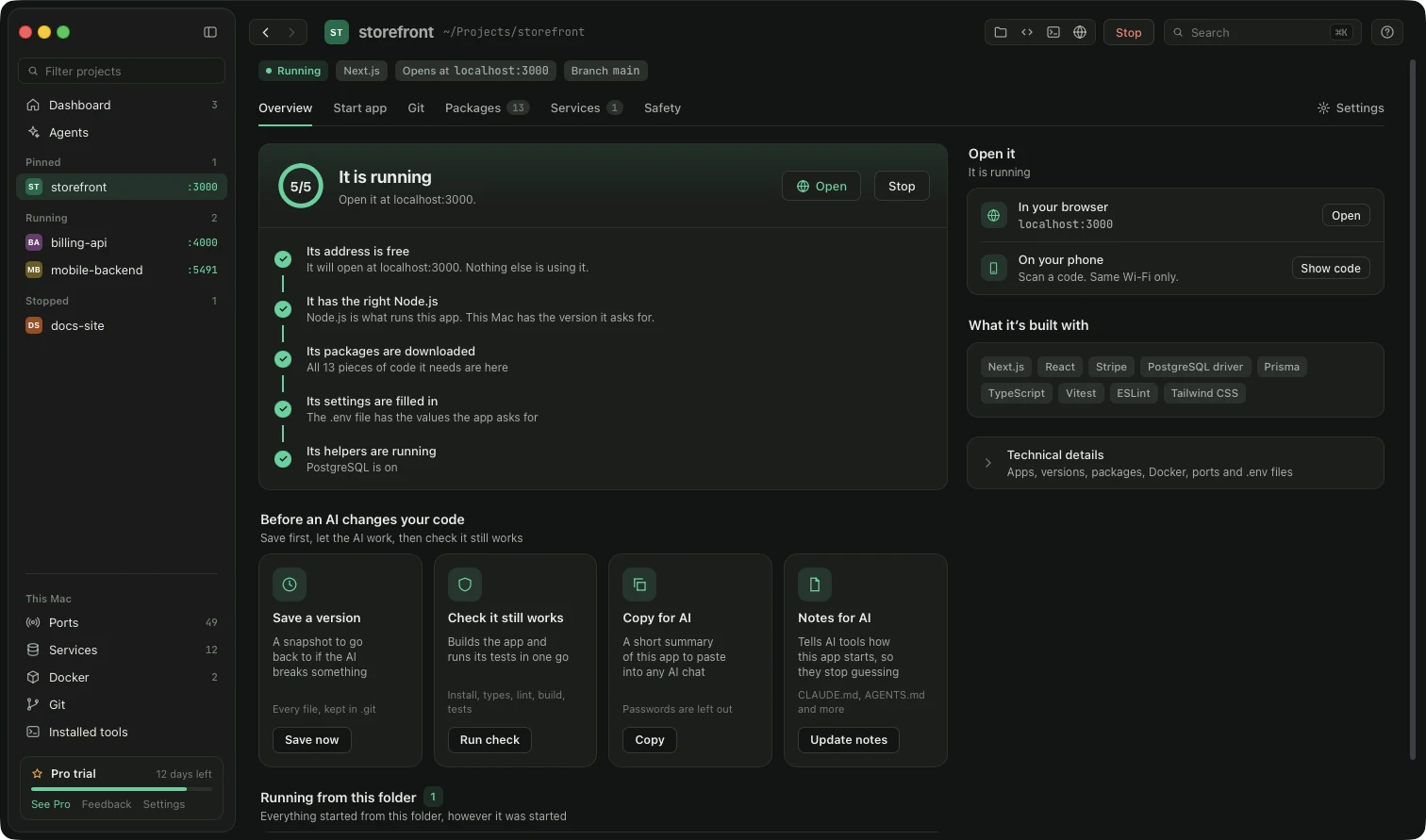
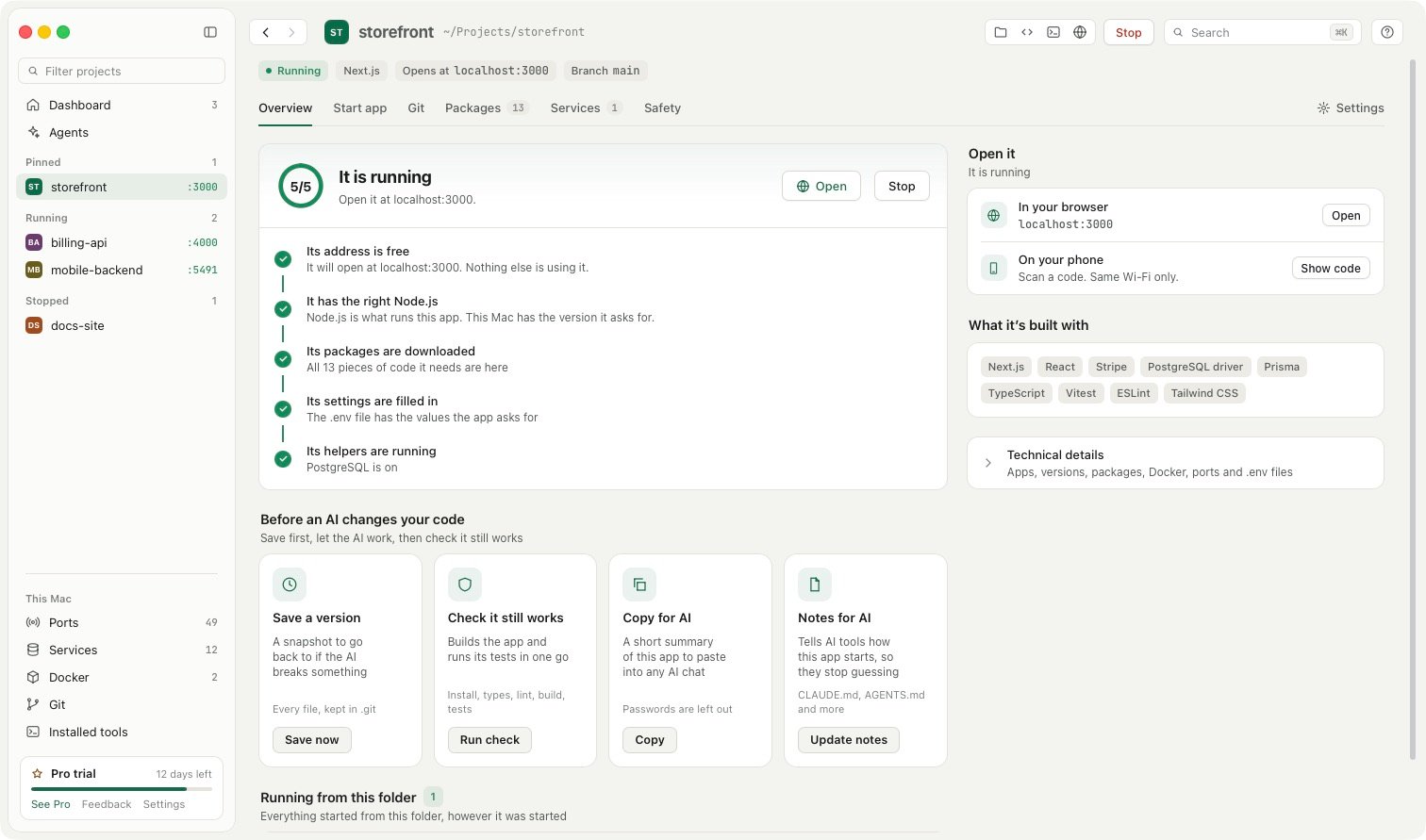
- Ports lists every listening port with its program and project, with Stop and Force.
- Why it will not start checks the port, the Node or PHP version, packages,
.envsettings and the database. - Installed tools shows every PHP and Node.js on the Mac and where each came from (Homebrew, nvm, Herd).
- Named addresses:
myapp.localhost(or.lokstack,.ls-dev) for any running project, Node apps included. - Lanes (Pro, beta) give each AI coding agent its own git worktree, port, database copy and address.
Pricing: free for personal and work use, with no time limit and no account. Pro is $79.99 a year ($39.99 the first year) for one person on up to 3 Macs, with a 14-day trial and no card. macOS 13 or newer.
Side by side#
| Feature | Laravel Valet | Lokstack |
|---|---|---|
| Main job | Serve PHP sites at .test | See and fix everything running for your projects |
| Interface | Command line | Mac app, with ⌘K for everything |
| Serves PHP sites (Nginx, HTTPS) | Yes | No |
| PHP versions | Yes, per site with valet isolate | Shows every PHP found; per project is Pro |
| Node.js projects | No | Yes |
| Local names | *.test for PHP sites, valet proxy for ports | *.localhost, .lokstack or .ls-dev for any running project |
| Databases | No (suggests DBngin) | Yes, PostgreSQL, MySQL and more via Homebrew |
| Docker | No | Yes, start, stop, logs and Compose |
| Every port and process on the Mac | No | Yes, free |
| Explains why a project will not start | No (valet diagnose shows Valet's own setup) | Yes, free |
| Separate copy per AI agent | No | Lanes (Pro, beta) |
| Price | Free, open source | Free; Pro $79.99 a year |
Where Valet is better#
If you live in the terminal and build PHP sites, Valet is hard to beat for what it does. It is free and open source, nearly invisible once installed, gives every folder a .test site with HTTPS on demand, and shares sites publicly in one command. Lokstack does not serve sites at all.
Where Lokstack is better#
Lokstack covers what Valet leaves out: Node apps, databases, Docker containers and the processes that pile up around them. It shows which program holds which port, explains why a project will not start, and gives AI agents their own lanes. And it gives any running project a name, not only PHP sites.
Using both together#
Many people run both. Valet keeps serving your PHP sites at .test, and Valet's Nginx and DnsMasq show up on Lokstack's Ports page next to everything else. Lokstack's Installed tools lists the Homebrew PHP versions Valet uses, so you can see which one a project is really getting.
Features checked on 24 October 2026 in the Laravel Valet documentation.